
Efficiency Isn’t the Goal. Better Coaching Is.

If you ask a room full of football coaches what they’re trying to improve this offseason, you’ll hear a lot of the same answers.
“We need to get more reps.”
“We need to practice faster.”
“We need to simplify communication.”
“We need to spend less time on things that don’t matter.”
Whether we realize it or not, we’re all talking about the same thing.
Efficiency.
Over the past decade, efficiency has become one of the biggest trends in football. Practices are scripted down to the minute. Video is available before players leave the locker room. Playbooks live on players’ phones. Communication happens instantly. Staffs share information faster than ever before.
None of that is a bad thing.
In fact, I think it’s one of the best developments in modern coaching.
But efficiency isn’t the destination.
It’s simply the vehicle that allows us to spend more time doing what matters most—developing players.
The danger comes when we become so focused on saving time that we stop investing time where it’s needed.
Efficiency requires intentional actions.
Time Is Every Coach’s Most Valuable Resource
No matter what level you coach, every staff has the same amount of time.
The practice clock doesn’t care if you’re a first-year assistant or a state championship head coach.
Everyone gets the same two-hour practice.
Everyone gets the same seven-day week.
The difference is how efficiently that time is used.
Every unnecessary transition...
Every player standing in line...
Every coach looking for equipment...
Every five-minute conversation that could have taken thirty seconds...
Those moments don’t seem significant individually, but over the course of an entire season they become hours of lost development.
The most efficient programs aren’t trying to save time because they dislike working.
They’re trying to create more opportunities to teach.
What an Efficient Practice Actually Looks Like
Too often coaches associate efficiency with speed.
I don’t think those two things are the same.
An efficient practice doesn’t necessarily move faster.
It simply eliminates wasted movement.
Before practice begins, equipment is already on the field.
Managers know exactly where every piece of equipment belongs.
Scout cards have already been distributed.
Every coach has the script.
Every player knows the practice schedule.
Transitions happen because everyone understands the expectation—not because coaches are yelling directions across the field.
Position drills begin immediately because coaches aren’t explaining organization.
They’re coaching technique.
One of the easiest ways to identify an efficient practice is to ask a simple question:
Are the coaches coaching, or are they organizing?
Great practices maximize coaching.
Poor practices maximize organization.
The less time you spend organizing, the more time you spend developing.
More Reps Lead to More Development
Every football coach wants more quality repetitions.
The question is how to create them.
Efficiency provides the answer.
Instead of waiting behind eight players in one drill, split the group in half.
Instead of running one offensive line station, create two stations teaching complementary techniques.
Instead of spending fifteen minutes installing before every drill, build drills that players already understand.
Instead of introducing ten new drills every offseason, become exceptional at six that teach multiple skills.
For example, offensive line coaches often spend the majority of individual time teaching footwork, leverage, hand placement, and communication.
Rather than creating separate drills for each concept every day, one well-designed inside zone progression can reinforce all four simultaneously.
The players receive more quality repetitions.
The coach provides more meaningful feedback.
Development accelerates.
Efficiency isn’t about doing less.
It’s about getting more out of every rep.
Technology Should Remove Friction, Not Replace Coaching
Technology has changed the way football staffs operate.
Film is available almost immediately after practice.
Players can watch cut-ups from home.
Practice scripts are shared digitally before coaches ever arrive at school.
Playbooks update instantly.
Communication platforms keep players, parents, and coaches on the same page.
Offensive coordinators can build call sheets collaboratively.
Defensive staffs can organize opponent tendencies with searchable reports instead of stacks of paper.
Some staffs use digital depth charts that automatically update every position coach.
Others build shared installation calendars so every coach knows exactly what is being taught each day.
Technology has made these tasks significantly easier.
But here’s the important reminder:
Technology doesn’t make someone a better football coach.
It simply removes friction from the coaching process.
If technology saves you thirty minutes, don’t use that time to leave earlier.
Use it to teach more.
Spend another period correcting offensive line footwork.
Review pursuit angles with your defense.
Meet individually with your quarterbacks.
Coach your young assistants.
Technology should never replace relationships.
It should create more opportunities for them.
Or do use it to leave earlier. Reward your players and coaches for the hard work they put in each day.
Weekend Work: Work Smarter, Not Longer
Saturday has traditionally been one of the longest days of the football week.
Many coaches have experienced the twelve-hour Saturday that somehow turns into fourteen.
The reality is that much of that time is often spent duplicating work.
The most efficient staffs divide responsibilities instead.
One coach studies offensive personnel.
Another charts formations and motions.
A third breaks down third-down tendencies.
Position coaches clip individual technique examples for their own players.
Someone else builds the scouting report presentation.
Instead of six coaches spending six hours doing one same job, six coaches spend fewer hours each completing six different jobs.
The result is a better scouting report in less time.
Organization matters just as much.
Coaches can start their Saturdays working separately and end the day with focused discussion that completes the game plan.
By Monday morning, practice scripts are already taking shape because everyone knows their responsibilities.
Working efficiently on weekends doesn’t mean working less.
It means eliminating duplication and maximizing collaboration.
Just as importantly, it allows coaches to spend meaningful time with their families and recharge mentally.
A rested coach is often a better teacher than a tired one.
Efficiency Doesn’t Require Expensive Technology
One misconception about efficiency is that it requires expensive software.
It doesn’t.
Some of the most organized football programs I’ve ever seen relied on systems rather than technology.
Practice scripts were printed and distributed before meetings.
Equipment managers followed the exact same setup every practice.
Drills stayed consistent from week to week.
Players knew where every period took place.
Coaches used identical terminology every day.
Nothing changed unless it needed to.
Consistency creates efficiency.
Delegation creates efficiency.
Preparation creates efficiency.
Experienced players can organize warm-ups.
Managers can prepare equipment.
Assistant coaches can own drill organization.
The head coach shouldn’t be responsible for every small task.
Every responsibility delegated appropriately creates another opportunity to coach.
Technology makes good systems better.
It rarely fixes poor systems.
Don’t Sacrifice Development for Efficiency
This may be the most important point of all.
Efficiency should never come at the expense of development.
Sometimes a drill needs to stop.
Sometimes a player needs five extra reps.
Sometimes a position group needs an additional ten minutes because they aren’t executing fundamentals.
That’s not inefficient.
That’s coaching.
I’ve watched practices that looked incredibly organized.
Every whistle happened on schedule.
Every transition was perfect.
Practice finished ten minutes early.
Yet very little teaching actually occurred.
The players completed drills.
They didn’t improve.
Development requires correction.
It requires repetition.
It requires asking questions.
It requires allowing mistakes before providing feedback.
Sometimes the best coaching moments aren’t part of the practice schedule.
They’re the extra conversation after practice.
The individual correction during water break.
The five additional reps for a backup player who finally understands the technique.
Those moments don’t always fit neatly into a stopwatch.
But they often produce the greatest growth.
Use Efficiency to Invest in What Matters
Imagine your staff saves fifteen minutes every practice.
What happens next?
Do you simply end practice earlier?
Or do you use those fifteen minutes to develop your freshman offensive linemen?
To install another situational football period?
To review goal-line defense?
To improve kickoff coverage?
To mentor your youngest assistant coach?
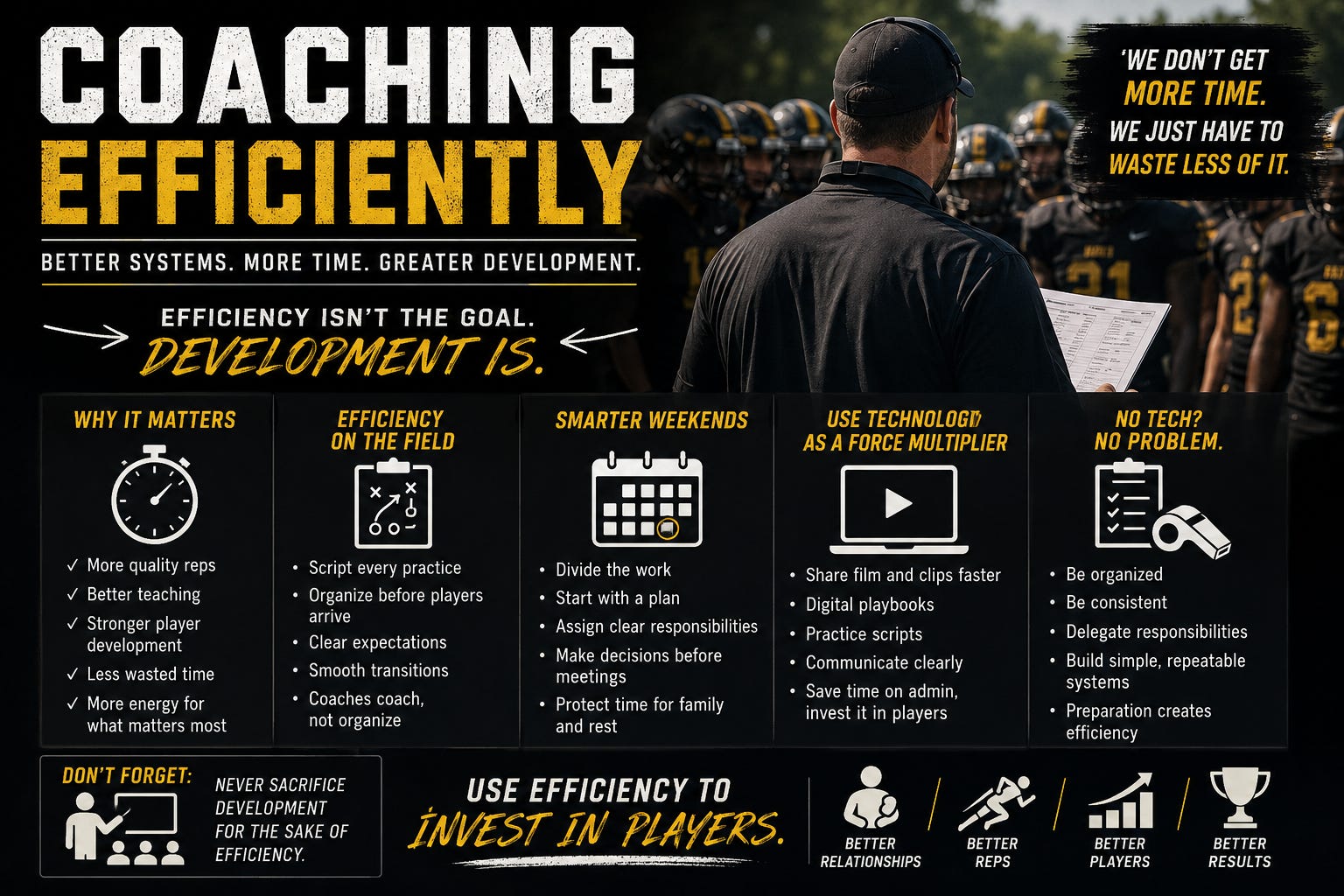
Efficiency only has value when it creates opportunities for better coaching.
The goal has never been to finish practice first.
The goal has always been to leave practice with better football players.
Final Thoughts
Football has evolved.
The way we communicate has changed.
Technology has improved.
Information is easier to access than ever before.
Those are all positive developments.
But the foundation of coaching hasn’t changed.
Players still need great teachers.
They still need repetition.
They still need feedback.
They still need relationships.
Become more efficient.
Script your practices.
Organize your weekends.
Delegate responsibilities.
Use technology to eliminate unnecessary work.
Build systems that simplify communication.
But remember why you’re doing it.
Efficiency is not the goal.
Player development is.
Everything else is simply a way to create more opportunities to coach.