
My Process

Every coach has their way of preparing for each week of the season. I’m sharing my process with you more as an exercise of review and examination for myself. I will approach this from the morning after a game and leading into and through the next game.
Film Review
The first thing I do on the morning after a game is watch our film to watch the offensive line and how they performed. I watch the End Zone view as much as possible. I find this angle allows me to focus intently on the OL, and also to see if the calls they made on each play are correct, according to the way the defense is aligned. I will go through each play, watching each player perform their assignment.
When I watch each clip I look to see if their first movement puts them in position to be successful, and then I look to see how they execute after contact. I prefer to write my notes in a notebook, with the play number and then the specific note for the specific player. On each clip I try to find something to improve and something to celebrate. I am not a grader, I don’t give pluses and minuses, or zeroes and ones. I try to be as clear as possible in the feedback I provide so the player understands exactly what went right and what needs more work.
I will watch the entire game in order to find at least one positive and one improvement needed for each player. Afterwards I will type out my notes to share with the players. I post all the notes with my game summary in our OL SportsYou group, so they can see my thoughts on each play.
At the beginning of the season, I will have lots of notes to share, but as the season goes, I try to pare down the notes to highlight the improvements we have made and the mistakes we still need to fix.
Sometimes during this process our offensive coordinator will want us to watch the game film together. While I still focus on the offensive line, it is the one time where I expand my view to see how the line play impacted the rest of the team's performance. I make it a point to not ask for many replays, unless I see something noteworthy that must be rewatched at that moment. I do this primarily because I believe this is the time where the coordinator should be given the time to explain how he sees the offense functioning. I make sure to make note of anything he points out to share with the guys.
Opponent Scout
Once my game review is complete, I will start on next week’s opponent. I like to watch three films max for the opponent, preferably their three most recent games. This tells me how they are playing now, and who is most likely to be in the lineup in our game. I don’t pay attention to player ratings or who the most recruited players are in the opponent. I prefer to watch them play and form my opinion on who is the best defensive lineman, who is the best box defender, and who is the best blitzer.
The first thing I look for is their base alignment. Are they an EVEN or an ODD Front? Many defenses today use multiple looks, but at their core they usually fall into one of those categories. I will draw up their base look against a common formation, like 10 personnel doubles. I only draw up their front because I pay no attention to how the secondary is aligned.
My job for breaking down the opponent is to input the front (EVEN or ODD) and blitz (YES or NO) into Hudl. During this time I am drawing up the different fronts the opponent uses and also each new and different blitz I see. This is also known as padding. When I pad, I like to use a graph paper notebook. I don’t know why, other than I feel it helps me draw out the proper spacing, and it just makes sense to the way I see it.
Once I’ve scouted and padded all three games, I will then go through my notes and look for their favorite blitzes and draw up our pass protection against it. We use a slide protection, and most of the time we don’t need to do any major adjustment to pick up each stunt. Occasionally we will see something the defense does that may make us flip the protection away from what the QB communicates us to do. The other OL coach and I will discuss what we think helps us the most, and then communicate that adjustment to the OC in order to be included in the game plan.
I do not draw up run plays against stunts because there really are not any adjustments to be made for us there beyond front identification and who/where the backers are. The main thing I look for that most impacts our run scheme is if the defensive line uses twist stunts. I make note of this and plan on working blocking twist stunts in both the run and the pass.
Now that my scout is complete, I will start putting the opponent stunts and fronts into my JustPlay playbook. I download the file to be uploaded into our SportsYou OL group, along with my explanation/summation of the opponent.
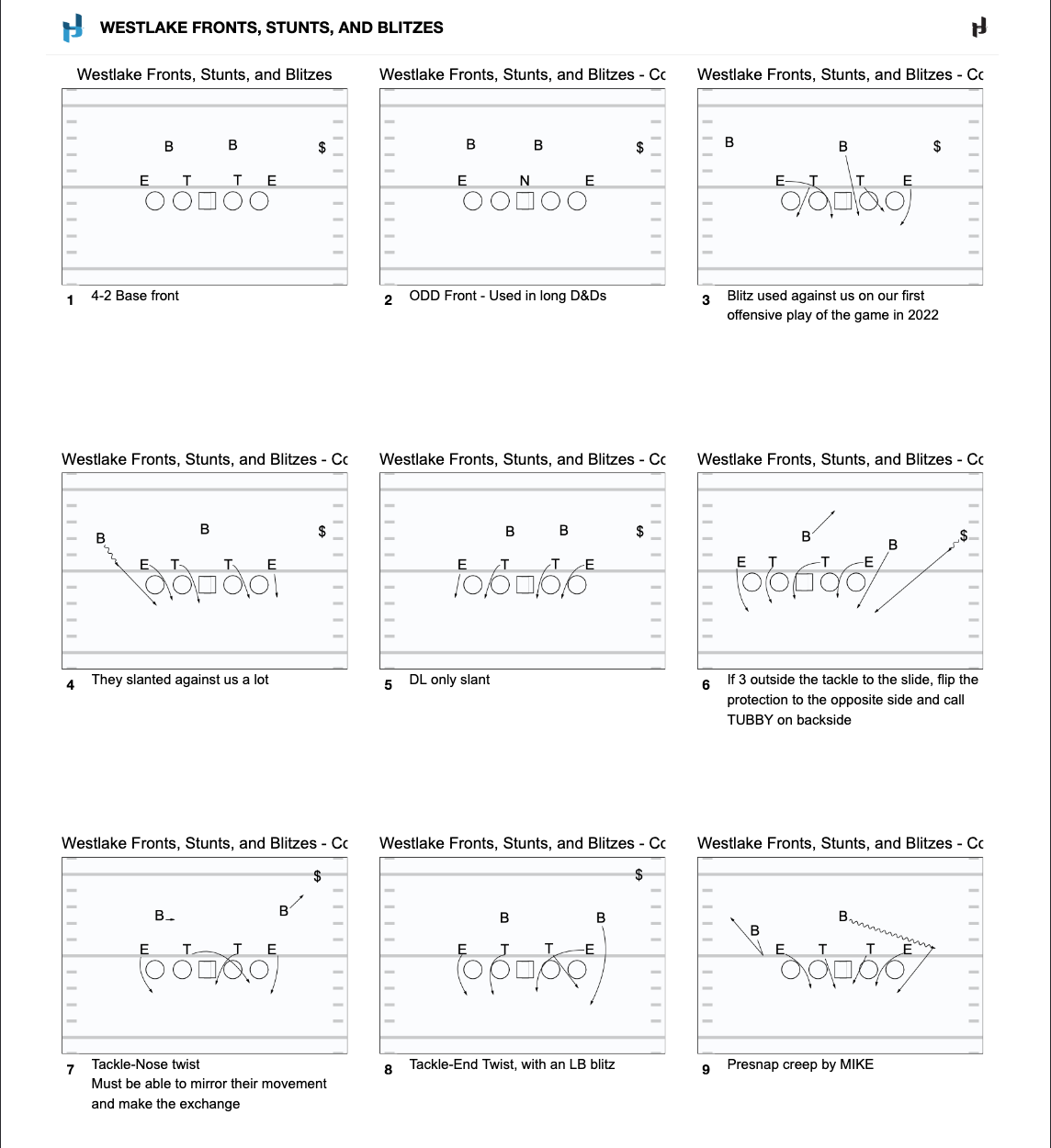
Example stunts file
This is all done by Sunday mid-afternoon and sent to the players for them to have the opportunity to start mentally preparing for the opponent.
Before leaving the office we will have a debrief of what we saw and discuss what we think will be good for us and what to focus the most on in practice the next week.
Practice
Ideally, before we step on the practice field to prepare for the next opponent, I like to have all of the previous opponent behind us. That is why I watch film with the offensive line on Monday mornings before school. Hopefully my players have already watched the film and gone over the notes I sent. Watching film together provides one more opportunity for the players to learn from me, and for me to hear what they were thinking and communicating during the game. As much as it is a film review, it is more about troubleshooting our communication process.
Once practice begins, the first thing we do is line up the base front and talk about the opponent’s defense this week. We talk about their strengths and weaknesses, their favorite stunts, and any adjustments we have this week. Since Monday individual time is the longest individual time of the week, this is the best time for us to have these discussions and walk through any new plays we are introducing and any adjustments we are making.
Now that we have previewed the opponent, we start blocking them. I like to work progressively from solo work, to combos, then full scheme. This gives us the opportunity to work our steps, our fits, and our communication. As far as drills go, we always try to do what is most reflective of what we want to see happening in the game. Centers snap every rep. When we do combo work we always partner with the people we play next to. I don’t believe in half-speed. I don’t know what that means and how to make it the same for everybody. It’s either walkthrough or game speed. Fast players are confident players.
The first two days of the practice week are also the only days of the week we get solo time against the defensive line. Players always want to do 1 v 1s, but I like to divide it up. One day we will work run blocking. Either combos, inside zone, or full scheme counter drills. The other day will be pass protection. Somedays this equates to 1 v 1s, others it may be full scheme protection. The OL and DL coaches talk to each other and decide what we need to see the most when we come together.
The rest of the week our indy time is mostly just enough time to get the OL moving and any quick coaching points we need to make regarding what we have seen in the way we are practicing. Days 3 and 4 of the practice week are more full unit and team, so I am working on giving quick coaching cues between reps.
Game Day
Now the day has come. Time to see if all of the mental and physical work done through the week will pay off. As a box coach, I use our pregame warm up time to get in my game reminders to each player, since I won’t talk to the full group again until halftime.
During the game I have my notebook ready to jot down quick thoughts. I used to draw up the front to make sure what I am seeing live is confirmed with what we scouted on film and practiced against. Now with SkyCoach I can confirm during the game. If I see something I want to look back at later, I will record the clip number and look between possessions. Sometimes I will look immediately if I see something go terribly wrong. As technology gets incorporated and adapted into the game, I have found that my conversations with the sideline OL coach and the players have changed in just one season. It is incredible how helpful these tools have been.
My halftime talks have evolved into more of a conversation about what we see working on film and what the offensive line likes or wants to try. Many corrections have already been communicated from the replay film to the players. Even though in Texas we have 28 minute halftimes, I only end up with about 5-10 minutes max to talk to the unit before needing to return to the booth.
My second half process is the same as the first, and once the game is done I am too. When I go home I don’t watch film until the following morning at the field house. It’s my mental reset time.
In Sum
Over my career, one thing I have learned is to give the OL as few things to think about as possible. I want to make sure to teach and practice the most important thing each time we come together. I consider myself somewhat of a unicorn in the offensive line coaching world because I actually can have enough individual time. When you keep things simple and similar, there is only so much drill work you can do. If you want to play fast in the game, you have to practice playing fast. It’s easier to do that against an actual defense.
Another thing about technology is coaches have access to an almost endless rolodex of drills, so if I ever need to find a new or different way to teach a skill all I have to do is a quick search or post a question online. The main thing I try to think about is if it will benefit our players and does it fit into what we do.
I would love to hear your thoughts on my process. Being adaptable is what helps you stay fresh in the profession. I also encourage you to write out your process prior to this season. Think about what you do and why you do it.