
Should Coaches Be Required to Be Teachers?

One question that comes up frequently whenever coaches from different parts of the country connect is whether coaches should be required to teach. It is a topic that usually generates strong opinions because coaching structures vary so much from state to state. In some places, most coaches are full-time teachers who coach. In others, schools employ coaches who spend most of their day focused on athletics.
As a Texas high school football coach, I have always known coaching and teaching to go hand in hand. The overwhelming majority of coaches in Texas are classroom teachers. It is simply part of the profession here. But as I have gotten to know coaches from around the country through #TXHSFBCHAT, I have come to appreciate that there are good arguments on both sides of the discussion.
The strongest argument for requiring coaches to be teachers is the impact it has on relationships. Coaches who teach are around their athletes every day. They see them in the classroom, in the hallways, at lunch, and throughout the school day. The relationship extends far beyond the football field or athletic period.
When a coach teaches, they gain a better understanding of who their players are as students and people. They see who is struggling academically, who needs encouragement, and who might be dealing with challenges outside of athletics. The classroom creates opportunities for interaction that simply do not exist when the only contact occurs during practice.
I have always believed one of the greatest strengths of Texas high school football is that coaches are educators first. Coaching is teaching. Whether we are teaching a double team, a cover 3 adjustment, or proper tackling technique, we are educators helping young people learn and grow. The skills required to be an effective teacher often translate directly into becoming a better coach.
Teaching also helps coaches stay connected to the mission of the school. Athletics is an important part of education, but it is still part of education. Coaches who spend their day in classrooms are constantly reminded that our responsibility extends beyond wins and losses.
At the same time, there are valid arguments for why coaches should not be required to teach.
The biggest argument is that coaching itself has become increasingly demanding. Today’s coaches are responsible for far more than practice plans and game preparation. They are involved in strength and conditioning programs, recruiting assistance, film breakdown, social media management, player development, fundraising, community outreach, and numerous administrative responsibilities.
Many coaches spend long hours before school, throughout the school day, after practice, and on weekends working to provide the best possible experience for their athletes. It is fair to ask whether adding a full teaching load limits the amount of time and energy they can devote to those responsibilities.
There is also the reality that some outstanding coaches may not have an interest in becoming classroom teachers. They may possess tremendous knowledge, leadership ability, and communication skills that could benefit student-athletes. Requiring them to teach could potentially discourage talented individuals from entering the profession.
As athletics continue to grow, some schools have explored models that allow coaches to focus more directly on athletic development. Supporters of these models argue that specialized coaching positions can help programs operate more efficiently and provide athletes with additional resources.
Both sides of the discussion raise important points.
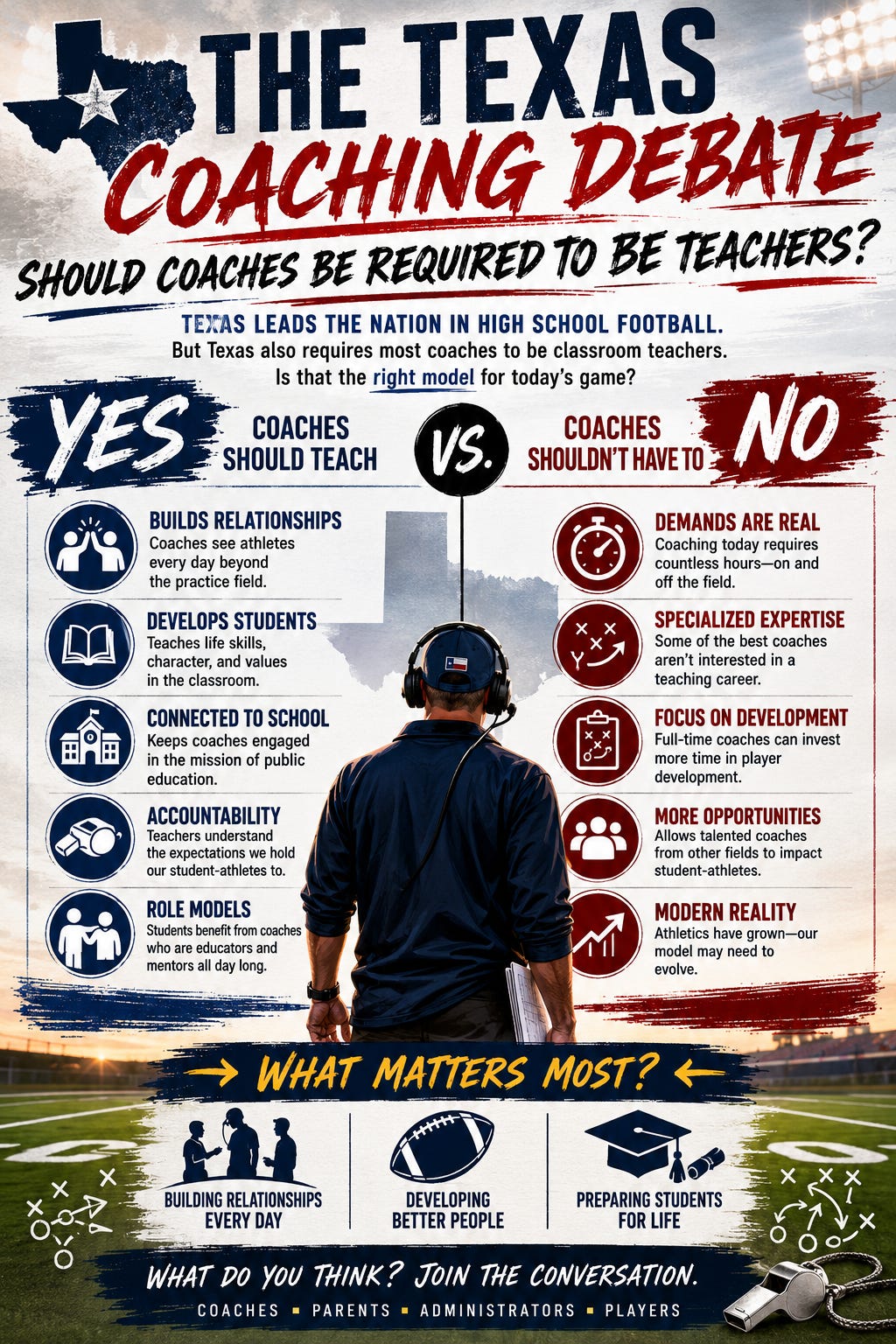
Personally, I still believe there is tremendous value in coaches being teachers. The relationships built during the school day are difficult to replace. The classroom gives coaches opportunities to influence young people that go far beyond athletics. It keeps us connected to the educational mission of our schools and reminds us that our purpose is developing students, not simply athletes.
However, I also understand why some schools and communities may choose a different approach. The demands placed on coaches today are significant, and there are talented individuals who can positively impact athletes even if they never stand in front of a classroom.
Perhaps the better question is not whether coaches should be required to teach, but how schools can ensure coaches remain connected to students and the educational mission of the campus regardless of their role.
At the end of the day, great coaching has always been about teaching. Whether that happens in an English classroom, a science lab, a weight room, or on a football field, the best coaches are still educators. They teach skills, build relationships, develop character, and help young people become better versions of themselves.
That responsibility exists whether there is a teaching certificate hanging on the wall or not.
Upcoming Clinics:
June 24-25 Lone Star Coaches Clinic
I would like to share a personal story about Coaches in Communities. I was on a staff for quite some time at a school in North Idaho. We had a staff of six. Five of us worked in the community with jobs outside the School District. Our lone school staff member was the HC. Here is my take on it, if you have a Teaching Certificate it does not make you a Coach because of that Certificate. The kids saw that the five of us worked 8 to 12 hour days or more. Came to practice on time each day, put forth the effort and showed that we cared for each and every one of them. We had a guy that would go to work at 1 a.m. work all day until 2 p.m., get to practice by 4 p.m. and was never late. He would leave practice go home and eat and back at it the next day. I think we provided a great role models for the kids to see and that it could be done in a professional way. We all stuck together and supported one another no matter the role on the team. To make the story shorter we won a State Title in 2016 with 5 community members and one School District employee. I think what gets lost in this is that we get pigeon holed into every school being big and having resources. That is not always the case, in fact a lot of community members do not get paid and volunteer their time for the kids and the love of the game. Consider this as well and maybe some of you have experienced this. Hire a Coach whether in the school or not, played next level ball, does that qualify them as a Coach? Same thing versus Certificated or not. I think the kids enjoy see different faces at practice time, team gatherings, etc. Both have their pros and cons. Working in the community the Coach must master the skill of time management, crucial as does working in a classroom. Texas is a lot different from Idaho. I have come across a lot of quality Coaches that do not work in the daily school system, several have State Titles to their resume.
You made a great argument in why teachers should be coaches. I actually agree with most of the reasoning. Can the same be said for a non instructional staff member like a custodian, security guard, etc being allowed to be a coach for a public school program? They also work in the schools and knows the students inside the school and out in some cases. In some schools, those staff members are usually the first ones who teachers call or ask for help with those students.
And a bonus to this is that those members are already checked and better as far as background checks. Or should be checked.
Just throwing another opinion out there. Have a good day.