
Simple Scheme Installation for an Up-Tempo Offense
AKA You Only Need a Few Run Plays to Go Fast

Simplicity of scheme and quick communication are of utmost importance to operate a multiple formation, multiple personnel offense played at an up-tempo pace. Our philosophy is built on simplicity leading to speed. In order to play fast, our players must receive information quickly, process it quickly, and communicate it efficiently across the offense.
A few base runs would include inside zone, outside zone, lead (iso), and one other run scheme. Once the formation and play are signaled in, the quarterback relays a one-word code identifying the blocking scheme and direction. That streamlined communication allows our offensive line to rapidly identify assignments and play with confidence at tempo.
Teach your run schemes in the order that best reinforces technique carryover and communication across the offense. Our lead blocking scheme has rules of blocking the near down lineman and leaving the playside inside linebacker unblocked for the fullback. Double teams that occur, due to two offensive linemen having the same near down lineman to block, will work together up to the near backside linebacker. We emphasize vertical movement on all double teams, with eyes working to the backside linebacker. Our goal is to create downhill seams for the running back while maintaining square shoulders at the point of attack.
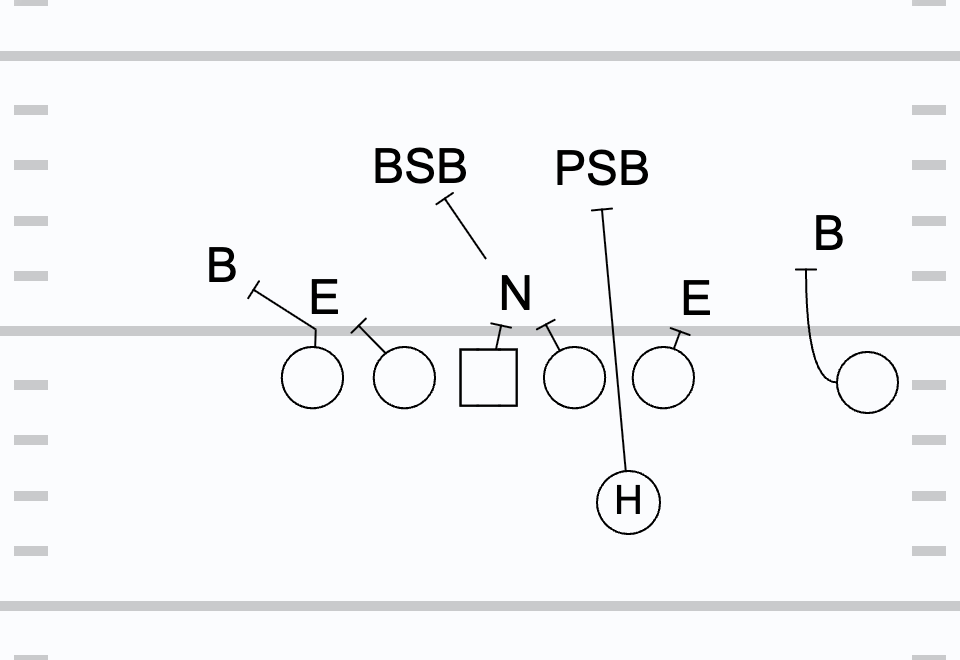
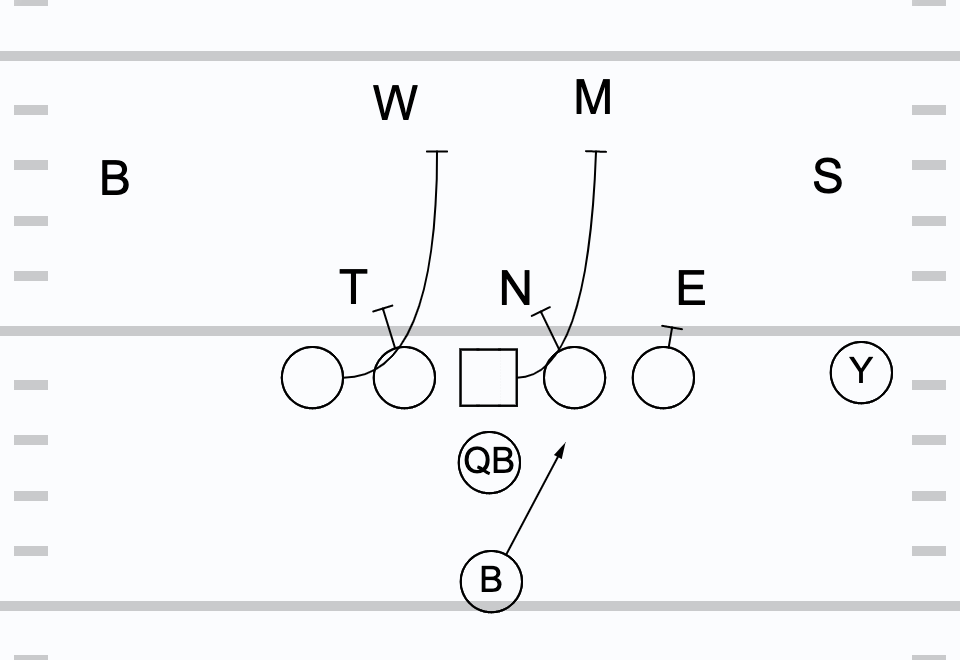
Lead is the first play because the blocking scheme is directly related to our pass protection. We employ a four man slide protection, with the direction of the slide called by the center. In the diagram below, the Center makes a “Rake” call meaning the right tackle is manned up with the five techniques, in this case.
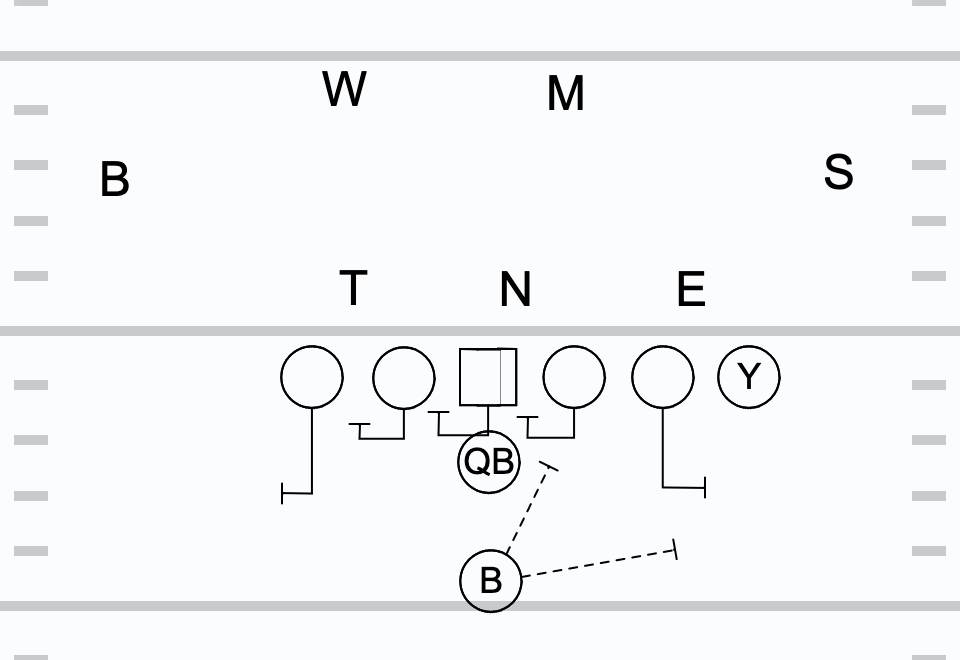
Beginning with the right guard, the rest of the offensive line is responsible for protecting the gap to their left. The center and right guard will both work the nose shade, looking for the weak inside linebacker to threaten the left side A gap. The running back is responsible for inside-out protection, looking first at the strong inside linebacker, then looking at the strong outside linebacker. We use this protection for our quick game passing, and for our five-step concept passing.
Next we install our inside and outside zone scheme. We introduce both schemes by teaching the steps for blocking to the right and then blocking to the left. For inside zone we teach the lateral step to get our feet under us to attack the defensive lineman and work for a leverage advantage. When running inside zone to the right, the lineman is responsible for the gap immediately to the right, and if there is no immediate threat, work up to the near backer. If the defensive line stunts, as long as the offensive lineman takes and trusts his steps, they can pick up whatever stunt occurs in front of them. We encourage our OL to help playside if their playside gap is uncovered as they work up to the backer. This allows for double teams to occur and results in first level vertical push.
Outside zone is probably my favorite run play of all time. Mobility on the offensive line is key, but so is their ability to work together to make the wall of blockers to run a good outside zone. To me it is the ultimate example of how an offensive line should operate. All five on the same page, working together, trusting each other, communicating, and physicality at the point of attack.
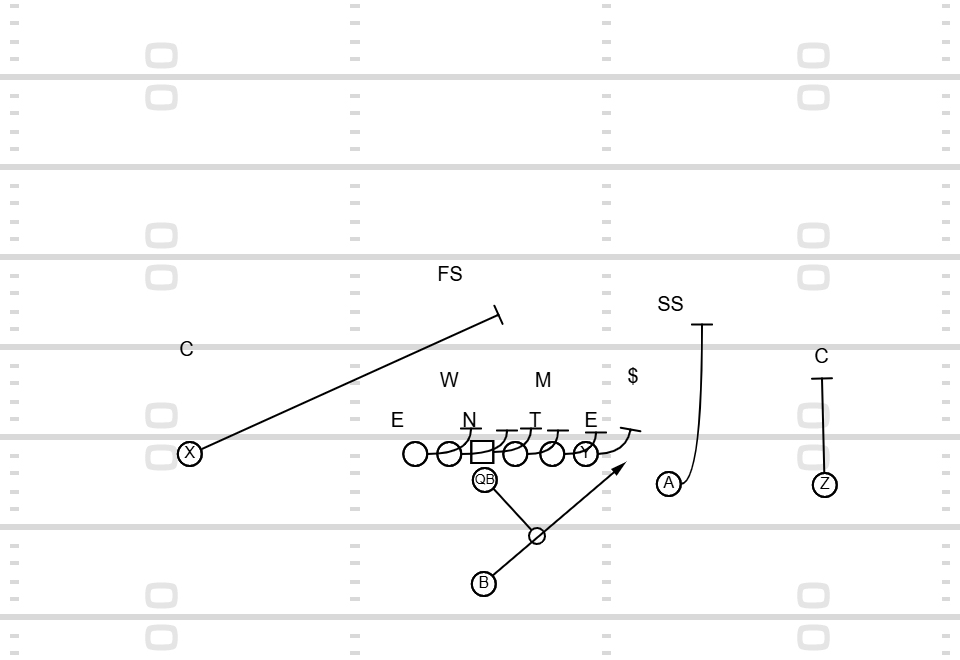
We teach the steps, with our playside elbow throwing our body open, followed by our second step, which is going from this open stance to a race to get to the next down lineman. The covered lineman should try to reach the defensive lineman and stay on the block until the uncovered lineman can get there to take over the block and bump the first offensive lineman up to cut a linebacker.
We incorporate read-options and run-pass options with our inside and outside zone runs. We use traditional reads when running our read-option with inside zone, with the quarterback reading the backside defensive end or outside linebacker if they squeeze down the line to play the cutback of the give, or if they stay at home to contain the quarterback. Against a 3-4 front, the read of the outside backer is used to run an easy run-pass option (RPO) on the backside of inside zone, in a two receiver formation to that side. We will run a slant or a quick seam with the receiver, filling the void if the linebacker plays the run. If he drops to cover the route, the quarterback can give.
Off of outside zone I like to incorporate our bubble screen. Run the bubble away from the outside zone blocking direction to influence the flow of the defense and isolate our bubble receiver. You can give your quarterback a give read on the bubble screen, if the receiver running the bubble is covered up in man coverage. This is a pre-snap RPO determined by where the defensive back covering the intended receiver is lined up. Upon recognizing coverage, the quarterback will either throw the bubble or give to the back to run outside zone.
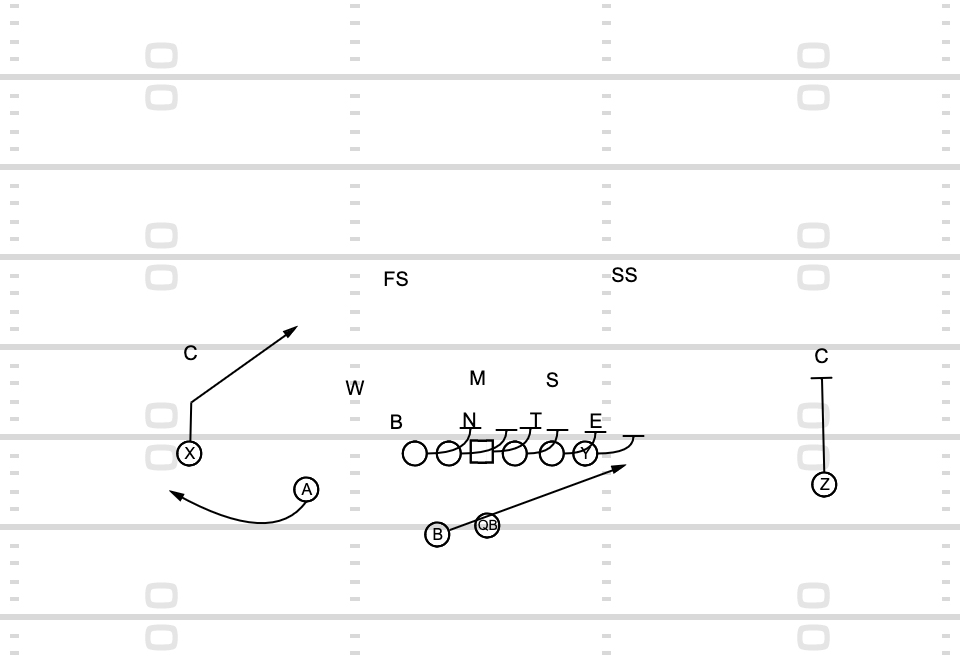
The last play I will discuss is a simple interior fold run. This can be used as a separate play or as an adjustment to an inside run. The blocking scheme is determined by the alignment of the defensive front, specifically where the nose shade is aligned. When running versus a 3-4, if the nose shade is on the right of the center and the play is going right, the center will tell the guard to block down on the nose and the center will fold up to the playside linebacker. The rest of the line has the same rule as our lead, block near down lineman. If the play is running to the right and the shade is to the left, the center will tell the left guard to fold, and the center will block down on the shade allowing the guard to fold up to the playside linebacker.
The beauty of this play occurs when the outside linebacker on the side of the 4i is walked off the line of scrimmage. Whenever we are given this defensive alignment against this play, the tackle that would block out on the backer is now free to fold up to the inside linebacker. When the tackle fold occurs on the same side as the guard fold, the play essentially turns into a double lead with both backers taken care of by the offensive line. The fold also provides a nice RPO due to the conflict of the linebacker responding to the fold, or staying to cover the slant being run by the inside receiver.
These base plays provide a small package of blocking schemes which allow for a number of plays to run at a fast tempo. By simplifying the thought process of the offensive line, we speed up their communication and easily identify their blocking responsibility on each play, leading to a successful offense.
Build your personal playbook with the platform used to create the diagrams in this article. MyJustPlay.com
Upcoming Clinics:
June 11-12 Rural Small School Football Summit
June 13 One Back Offensive Clinic
June 24-25 Lone Star Coaches Clinic